What Is Vibe Coding? The Shift in How We Build Software
From Karpathy's tweet to Apple blocking apps. What vibe coding is, where it works, and where it breaks down in 2026.

On February 2, 2025, Andrej Karpathy posted this on X:
"There's a new kind of coding I call 'vibe coding', where you fully give in to the vibes, embrace exponentials, and forget that the code even exists."
It sounded like a throwaway thought. Karpathy himself later said he couldn't predict tweet engagement "at all" and called it a "shower thoughts" post. But the phrase stuck. Collins Dictionary named "vibe coding" its 2025 Word of the Year. And by March 2026, it's become one of the most debated concepts in software development.
How It Differs from AI-Assisted Coding
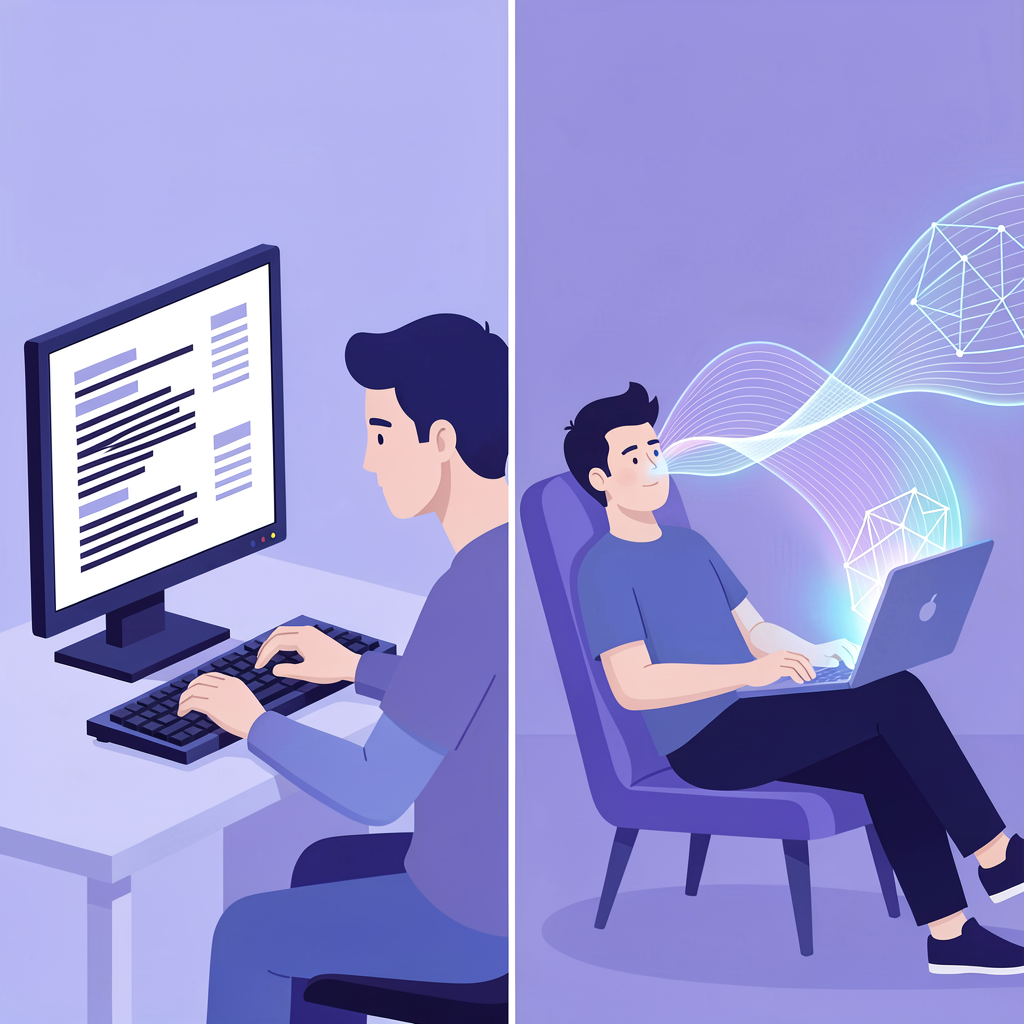
AI coding tools have been around for years. GitHub Copilot was suggesting autocomplete lines back in 2022. The difference with vibe coding isn't the tools — it's the approach.
Traditional AI-assisted coding keeps the developer in control. You write code, AI suggests the next line, you accept or reject. You're the driver; AI is the GPS.
Vibe coding flips that. You describe what you want in plain English — "build a login page with OAuth" — and the AI writes the entire thing. You might not read a single line. If the result works, you move on. If it doesn't, you paste the error back and let the AI try again. The code becomes an implementation detail you don't necessarily engage with.
In practice, it's a spectrum. Some developers review every line of AI output. Others truly "forget that the code exists." What they share is that the AI does most of the writing.
The Numbers in March 2026
The adoption curve has been steep.
- 92% of US developers use AI coding tools daily (Second Talent, 2026)
- About 41% of all new code is AI-generated globally
- 87% of Fortune 500 companies have adopted AI coding platforms
- The market hit $4.7 billion in 2026, projected to reach $12.3 billion by 2027 (CAGR ~38%)
- 21% of Y Combinator's Winter 2025 cohort had codebases that were 91%+ AI-generated
A year ago the conversation was "have you tried AI coding tools?" Now it's "who isn't using them?"
What Happened This Week
Vibe coding isn't a static trend. Just in the third week of March 2026, two major stories broke in opposite directions.
Google goes all in (March 20)
Google announced a full-stack vibe coding experience in AI Studio, integrating the Antigravity coding agent with Firebase backend support. Write a prompt, get a complete app — frontend, backend, authentication, database, deployment. The agent detects when you need Firestore or Firebase Auth and offers to set them up automatically. Google says the tool has already been used internally to build hundreds of thousands of apps.
Apple pushes back (March 18)
Apple quietly blocked App Store updates for vibe coding apps including Replit and Vibecode. The stated reason: these apps violate long-standing rules against executing code that alters an app's own functionality. Specifically, when Replit generates an app and displays it in an embedded web view, Apple considers that a rule breach. Since its last update in January, Replit's mobile app dropped from first to third place in Apple's free developer tools rankings.
Google is pushing the accelerator. Apple is pumping the brakes. That tension alone tells you vibe coding is anything but trivial.
The Tooling Landscape
Vibe coding tools fall into three categories.
IDE-integrated — Cursor and Windsurf work inside your editor. You see the code, chat with AI alongside it, and stay in familiar territory. Good for developers who want AI assistance while keeping their hands on the wheel. Cursor is $20/month, Windsurf is $15/month.
Terminal agents — Claude Code is the main example. You run it from the command line, give natural language instructions, and the AI navigates your codebase, edits files, runs tests, and handles git operations autonomously. Better suited for developers comfortable with CLI workflows who want to delegate entire tasks.
No-code builders — Lovable, Replit, and now Google AI Studio. No programming experience needed. Describe your app in words and get working software. This is closest to what Karpathy originally described.
For a deeper comparison of individual tools, see Top 5 AI Coding Tools Compared.
Where It Works and Where It Breaks
Vibe coding isn't universally effective. The line between "productive" and "risky" is fairly clear.
Where it works well
- Prototypes and MVPs: Validating ideas fast. Hackathon demos built with vibe coding are now routine
- Standard CRUD apps: Dashboards, admin panels, forms — anything with well-established patterns
- Boilerplate: Config files, repetitive API endpoints, test case scaffolding
- Personal tooling: Scripts and automation for your own use
Where the data gets uncomfortable

CodeRabbit analysis (December 2025) — Studying 470 GitHub pull requests, researchers found AI co-authored code had 1.7x more "major" issues than human-only code. XSS vulnerabilities were 2.74x higher. Insecure deserialization was 1.82x more common. Logic errors were 1.75x more frequent.
METR study (July 2025) — A randomized controlled trial with 16 experienced developers on large open-source projects (22k+ stars, 1M+ lines). The finding: developers using AI tools were 19% slower. The kicker — those same developers estimated they'd been 20% faster. The gap between perception and reality was a 39-point swing.
Veracode (2025) — Approximately 45% of AI-generated code samples failed security tests, hitting critical vulnerabilities from the OWASP Top 10.
The throughput is there. The accuracy and safety aren't always keeping up.
The Open Source Problem
In January 2026, a paper titled "Vibe Coding Kills Open Source" appeared on arxiv (2601.15494). The argument: when AI agents assemble software from open-source libraries, users stop reading documentation, filing bug reports, and participating in communities. The feedback loop that sustains open source breaks.
The signs are already visible. Tailwind CSS sees growing npm downloads but its documentation traffic dropped about 40% since early 2023, and revenue fell close to 80%. Stack Overflow activity declined roughly 25% within six months of ChatGPT's launch. cURL maintainer Daniel Stenberg shut down the project's bug bounty after AI-generated submissions hit 20%.
These aren't isolated incidents. They point to a structural tension: vibe coding increases the consumption of open source while decreasing the engagement that funds and maintains it.
Making Vibe Coding Work
A few principles separate productive vibe coding from reckless vibe coding.
Version control is non-negotiable. AI agents modify files directly. Without git, there's no undo. Commit before you prompt, review diffs after.
Don't skip code review. AI-generated code is still code that needs human verification. The CodeRabbit numbers make the case clearly enough.
Know where the prototype ends. An MVP built in a weekend is not production-ready software. The gap between "it runs" and "it's reliable, secure, and maintainable" is where most vibe coding projects fail.
Fundamentals matter more, not less. If you can't evaluate the code AI writes, you can't catch its mistakes. Debugging skills, architecture judgment, and security awareness become more important in a world where code generation is cheap.
Where This Goes
The terminology is already evolving. The New Stack introduced "agentic engineering" — the idea that AI agents don't just write code but autonomously design, build, and iterate on software systems.
The developer's role is shifting from "person who writes code" to "person who defines intent and verifies output." Time spent typing code shrinks. Time spent deciding what to build, evaluating quality, and understanding tradeoffs grows.
Six months ago, vibe coding looked different than it does today. Apple is blocking it. Google is betting on it. The open source community is sounding alarms. Where it goes from here is genuinely uncertain. But ignoring it isn't an option anymore.