Fine-Tuning vs RAG: Choosing the Right Approach
Two ways to customize LLMs for your data. Comparing cost, performance, maintenance, and when to use each.
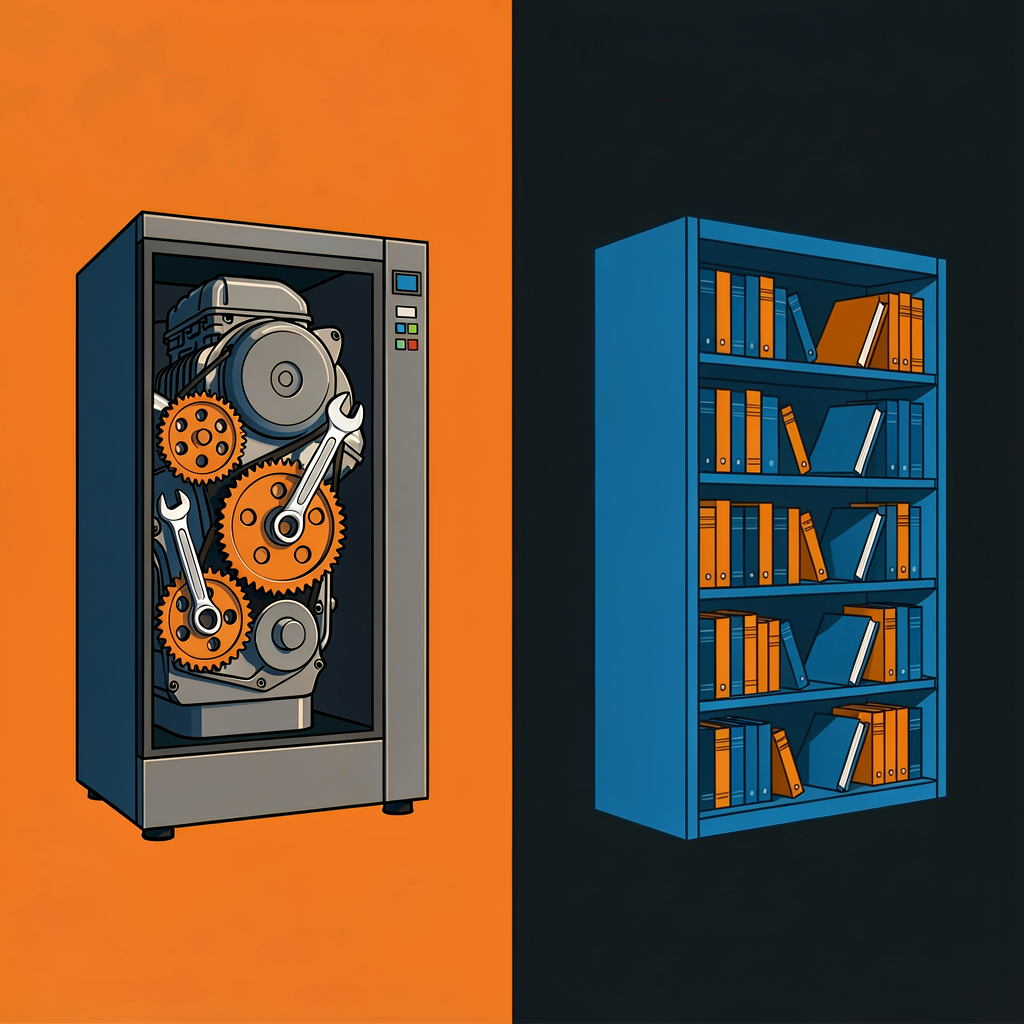
Work with LLMs long enough and you hit the same wall: "How do I make this model know about our data?" General-purpose models are smart, but they don't know your company's internal docs, your domain-specific terminology, or your organization's rules. They can't. That information wasn't in their training data.
Two main approaches exist: fine-tuning and RAG (Retrieval-Augmented Generation). Both aim to give an LLM new knowledge, but they work in completely different ways.
What Fine-Tuning Is
You take an existing LLM and retrain its weights on additional data.
Think of it like this: if a general-purpose AI is a medical school graduate, fine-tuning is residency training. You feed it concentrated domain-specific data to change the model's behavior itself.
The process:
- Prepare training data (question-answer pairs or text datasets)
- Update some or all of the model's weights
- Out comes a modified model
Techniques like LoRA and QLoRA made it possible to train only a small subset of parameters instead of the whole model. This is called PEFT (Parameter-Efficient Fine-Tuning) — it uses dramatically less GPU compute while still producing solid results.
What RAG Is
The model stays untouched. Instead, when a question comes in, you search for relevant documents and feed them into the prompt alongside the question.
Think open-book exam. The model doesn't "know" the answer — it reads reference material and responds based on that.
The flow:
- Split documents into chunks and store them in a vector database
- When a user asks a question, search for relevant chunks
- Inject the search results into the prompt as context
- The LLM generates an answer using that context
The model itself doesn't change. Only its input does.
Head-to-Head Comparison
| Fine-Tuning | RAG | |
|---|---|---|
| Model changes | Weights modified | Model unchanged |
| Knowledge updates | Requires retraining | Swap documents |
| Upfront cost | High (GPU, data prep) | Medium (vector DB setup) |
| Running cost | Lower (inference only) | Medium (search + inference) |
| Data freshness | Frozen until retrained | Near real-time |
| Hallucination | Hard to control | Mitigated by citing sources |
| Response speed | Fast | Slower (search step added) |
| Implementation difficulty | High | Medium |
At first glance, RAG looks better across the board. And for most projects, RAG is the first choice. But there are clear cases where fine-tuning is the right call.
When Fine-Tuning Makes Sense
You need to change how the model behaves. Specific tone, specific output format, natural use of domain jargon. RAG injects knowledge, but controlling how the model delivers that knowledge is harder with RAG alone.
Say you're building for the legal domain. You want answers in a legal expert's tone, with proper statute citation formatting and a consistent structure. Fine-tuning handles that well.
You need to reduce inference cost. RAG searches and injects long context every time, which burns tokens. A fine-tuned model has knowledge internalized and can produce answers from shorter prompts. For high-traffic services, this difference directly hits the bill.
You need peak accuracy on a specific task. Sentiment analysis, classification, structured data extraction — if a general model scores 80%, fine-tuning on task-specific data can push it to 95%. You can even fine-tune a smaller model to match a larger model's performance on a narrow task.
When RAG Makes Sense
Your data changes frequently. This is RAG's killer feature. New document? Update the vector DB. Modified document? Re-embed it. Fine-tuning requires retraining the model every time data changes, which isn't realistic for most organizations.
Internal wikis, product manuals, customer FAQs — any document collection that gets regular updates is a natural fit for RAG.
You need to show your sources. RAG answers reference specific documents, so you can say "this answer is based on paragraph 3 of document X." Fine-tuned models "just know" things, making it hard to trace where an answer came from.
In healthcare, legal, and finance, answer provenance matters. When hallucination occurs, having the referenced documents lets you verify: "the source material doesn't actually say that."
You need to ship fast. A RAG pipeline prototype can be built in days. Fine-tuning requires data cleaning, training runs, and evaluation — weeks at minimum. Starting with RAG, identifying gaps, then adding fine-tuning where needed is the pragmatic path.
Cost Breakdown
The cost structures are fundamentally different.
Fine-tuning costs:
- Initial training: GPU fees (tens to thousands of dollars depending on model size)
- Data preparation: labeling and cleaning labor
- Retraining: repeated cost when data changes
- Inference: similar to or slightly cheaper than base model (shorter prompts)
RAG costs:
- Vector DB hosting: tens to hundreds of dollars/month (managed services)
- Embedding generation: proportional to document volume
- Inference: higher token consumption due to longer context
- Search infrastructure: ongoing operational cost
At small scale, RAG is cheaper. But as call volume grows, the per-request cost of searching and injecting long context accumulates. At some point, fine-tuning becomes more cost-efficient. Where that crossover happens depends on your usage patterns.
The Hybrid Approach
In practice, combining both is often the most effective strategy.
The most common pattern: fine-tune for behavior, RAG for knowledge. Train the model on your domain's tone and output format, then supply real-time data through RAG retrieval.
[Fine-tuning] Model trained to respond in legal document format
    +
[RAG] Latest case law and statutes retrieved as context
    =
System that answers in domain-expert style using current legal information
Another pattern: use RAG outputs as fine-tuning data. Run a RAG system, collect high-quality question-answer pairs over time, then use those pairs to fine-tune the model. A feedback loop where model performance improves naturally.
Decision Framework
Not sure which to pick? Work through these questions:
- Does your data change often? — Yes means RAG first
- Do you need to cite sources? — Yes means RAG first
- Do you need to change tone, style, or output format? — Consider fine-tuning
- Do you need maximum accuracy on a specific task? — Consider fine-tuning
- Is call volume very high? — Fine-tuning may be more cost-efficient
Most cases fall into questions 1 and 2, which is why RAG is usually the starting point. When performance gaps appear in specific areas, add targeted fine-tuning.
One more thing. Whether you pick fine-tuning or RAG, good data is the foundation. Fine-tuning quality depends on training data quality. RAG answer quality depends on document quality. Before debating the tech stack, get your data in order.