Multimodal AI Explained — Text, Images, Audio in One Model
How multimodal AI works, key models in 2026, real-world use cases, and current limitations.
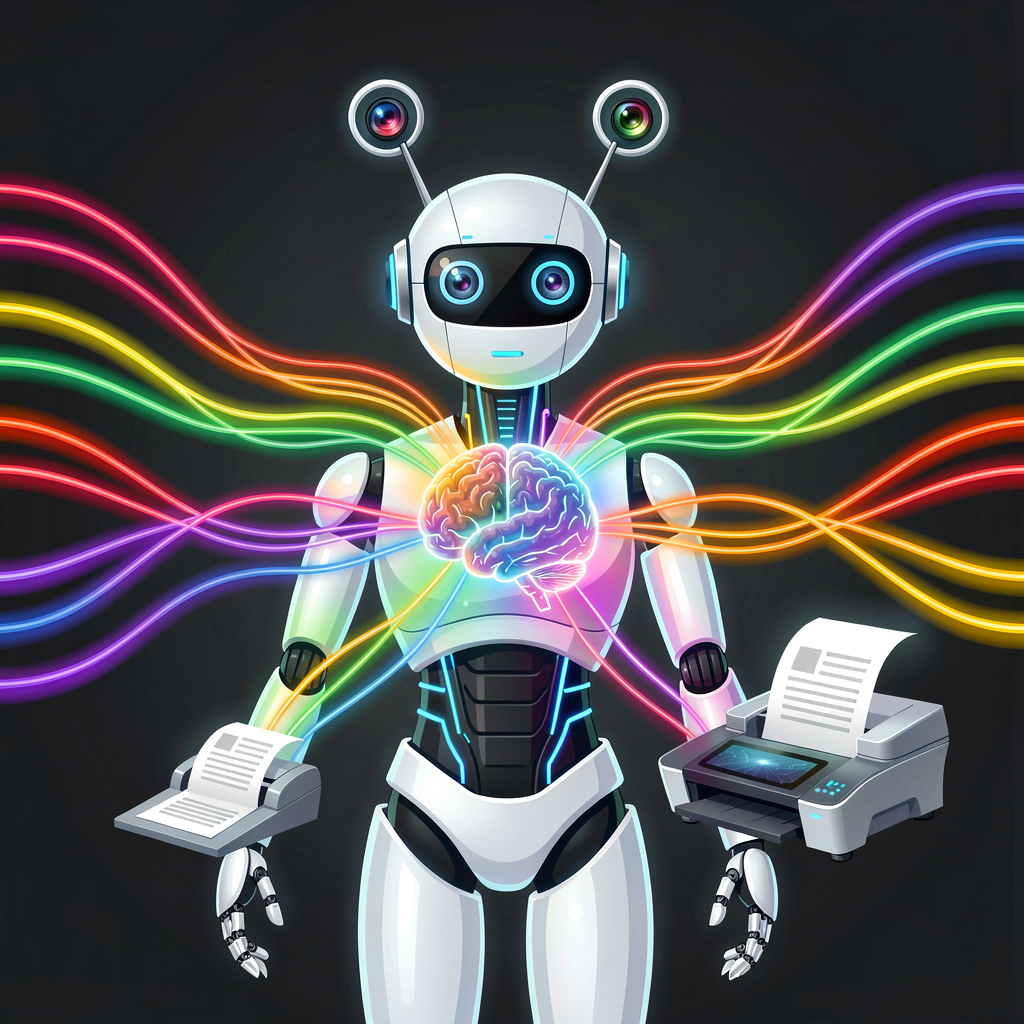
Think about early ChatGPT. You typed text, it returned text. That was it. Show it an image — nothing. Play it audio — nothing. Now? You snap a photo and it describes what's in it, hold a voice conversation, even analyze video.
The technology behind this shift is multimodal AI.
What Multimodal Means
The term is straightforward. Multi (many) + modal (modes/types). A multimodal AI can process multiple types of input simultaneously — text, images, audio, video.
Older AI models were single-modal. A text model, an image model, a speech model. Each worked only within its own domain. Multimodal AI breaks those walls down. One model reads text, sees images, and hears audio.
It's similar to how humans perceive the world. We don't judge things by reading text alone. We read facial expressions, hear tone of voice, observe the environment. We synthesize multiple streams of information. Multimodal AI aims for that same kind of integration.
How It Differs from Text-Only LLMs
A text-only LLM like GPT-3.5 dealt exclusively in tokens (text fragments). Text in, text out. It could understand the question "What's in this image?" but couldn't actually look at any image.
Multimodal models are architecturally different. They can process image pixel data and audio waveform data alongside text. When you feed in an image, a vision encoder converts it to vectors that get aligned with the language model's embedding space. So asking "Where is this building in the photo?" gets answered using both the image and the text simultaneously.
The key difference:
- Text LLM: text input → text output
- Multimodal AI: text + image + audio input → text (+ image/audio) output
The output side is increasingly multimodal too. GPT-4o handles text responses, image generation, and speech synthesis all within a single model.
How It Works Under the Hood
Simplified to three stages:
Stage 1: Convert each modality to vectors
Text goes through a tokenizer, images through a vision encoder (usually ViT-based), audio through an audio encoder. Different data formats get mapped into the same mathematical space.
Stage 2: Align in a shared embedding space
The converted vectors get placed in a common space. The model learns that "a photo of a cat" and the text "cat" should be close together in vector space. CLIP is a well-known example of a model that handles this alignment.
Stage 3: Process through a transformer
The aligned vectors feed into a transformer architecture where text tokens and image tokens attend to each other, capturing cross-modal relationships.
Image → Vision Encoder → Image Tokens
Text  → Tokenizer      → Text Tokens
                              ↓
               Transformer (Cross-Attention)
                              ↓
                        Unified Output
Implementation details vary by model. Some train as multimodal from scratch (native multimodal), others bolt a vision module onto a text model. The native approach produces more natural integration but costs significantly more to train.
Notable Models in 2026
GPT-5.4
OpenAI's latest (March 2026). The native multimodal architecture that started with GPT-4o has evolved significantly through the GPT-5 series. It processes text, images, and audio in a single model with a 1M+ token context window for handling large multimodal inputs at once.
The audio processing stands out. What used to require a pipeline of separate models — speech-to-text, LLM processing, text-to-speech — now happens end-to-end in one model. Computer use capabilities are also built in natively.
Claude 4.6 (Opus / Sonnet)
Anthropic's latest. Both Opus 4.6 (February 2026) and Sonnet 4.6 support image input, with particular strength in document analysis. Feed a complex PDF with tables, graphs, and charts into that 1M token context window, and it handles structure recognition and data extraction well.
It can also analyze screenshots containing code. Capture an error screen, show it to Claude, and it'll identify the issue and suggest fixes.
Gemini 3.1 Pro
Google's latest multimodal model (February 2026), evolved rapidly through the 2.x and 3.x series. Its biggest strength is the long context window — 1 million tokens. That makes it strong for scenarios involving long videos or large batches of images. You can feed an entire YouTube video and ask for a summary.
Integration with Google's search infrastructure is another differentiator, and TTS models are being folded into Gemini as well.
Open Source
Qwen 3.5 (with multimodal support), Llama 4, and InternVL are advancing fast. If 2025 was the year open-source LLMs closed the gap with commercial models, 2026 is when they started matching or exceeding them in many areas. The ability to run locally is the main draw, especially for environments where sending sensitive data to external APIs isn't an option.
Real-World Applications
Document Analysis
The most active use case right now. Feed scanned documents, receipts, contracts, or research papers into an AI, and it extracts text, structures tables, and summarizes key content. Far more accurate than traditional OCR and much better at understanding context.
A complex financial statement as an image doesn't just get its numbers read — the model can interpret that "revenue increased 15% year over year."
Accessibility
Image description for visually impaired users is a major application. Apps like Be My AI already let users point their camera at something and get an audio description: "There's a crosswalk ahead, the light is red."
Medical Imaging
X-rays, CT scans, MRI — multimodal AI is being used to detect anomalies. The potential as a diagnostic aid is high, though regulatory and reliability concerns mean it's still a supplementary tool rather than a replacement for physician judgment.
Code + UI Analysis
Show the AI a design mockup (Figma screenshot, etc.) and ask it to generate React code — the output is surprisingly usable as a starting point. Not production-ready, but solid for a first draft. Showing error screenshots for debugging is also a common workflow.
Education
Take a photo of a textbook page, feed it to an AI, and it solves problems or explains concepts. Math works particularly well. It even recognizes handwritten equations and walks through solutions step by step.
Limitations
This technology isn't perfect. Several clear limitations remain.
Hallucinations persist. The model sometimes misreads images. Fine text in images gets garbled, context gets misinterpreted, and number recognition isn't 100% reliable.
Spatial reasoning is weak. Ask "What's the object on the left?" and it might point to the right. Accurately understanding direction and positional relationships still needs work.
Cost. Multimodal input burns through tokens faster than text. A single image can cost hundreds to thousands of tokens, making API costs significantly higher. Batch processing requires careful cost calculation.
Privacy. Image and audio data is more likely to contain sensitive personal information than text. Sending photos with faces or voice recordings to external APIs raises legitimate privacy questions.
Where It's Heading
Real-time video understanding is becoming practical. Sharing your screen and having a live conversation with an AI — Google's Project Astra and OpenAI's Advanced Voice Mode are pushing this direction.
Modalities are expanding too. Models that process tactile sensor data, 3D spatial data, and other sensor inputs are in research. The intersection with robotics is getting particular attention.
And there's the push toward running smaller but equally capable models. The goal is multimodal AI running locally on a smartphone. Once on-device AI becomes widespread, many of the privacy concerns resolve themselves.
AI went from text-only to seeing and hearing. It's still well short of human perception, but given the pace of development, that gap is closing faster than most people expected.