Getting Started with Docker: A Practical Guide
Docker explained from containers to Compose. Core concepts, essential commands, and common mistakes to avoid.
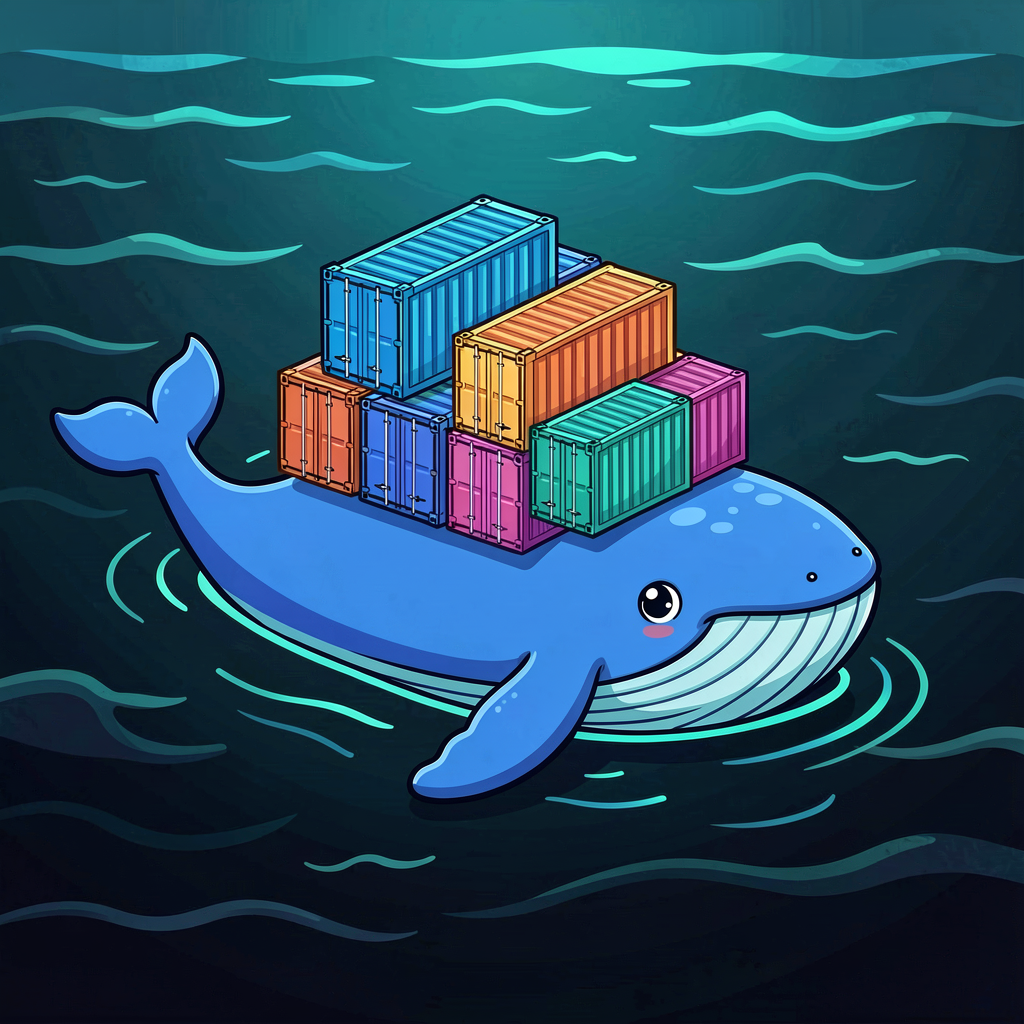
"It works on my machine" — every developer has either said this or heard it at least once. Your app runs perfectly locally, deploy it to a server, and it breaks. Different Node.js version. Python dependency conflict. Missing environment variable. Problems caused by environment differences.
Docker solves this. It packages the environment your app needs so it runs identically everywhere.
What Containers Are
Comparing to virtual machines (VMs) makes this click faster.
A VM virtualizes an entire operating system. You put a hypervisor on the host OS, install a guest OS on top, then run your app inside that. Heavy. A single Ubuntu VM eats several GB of disk and takes minutes to boot.
Containers share the host OS kernel. No guest OS needed, so they're lightweight. Image sizes are tens to hundreds of MB, and startup takes 1–2 seconds. The trade-off: since they share the kernel, Linux containers run on Linux. (On Mac and Windows, Docker runs a lightweight Linux VM under the hood to host the containers.)
The key concept is isolation. Each container gets its own filesystem, network, and process space. Container A running Node 20 and Container B running Node 18 don't interfere with each other.
Why Use Docker
First, environment consistency. Dev, test, and production environments are identical, so "works on my machine" stops being a problem.
Second, fast onboarding. When a new team member joins, instead of "install this, configure that, then..." it's just docker compose up and the development environment is ready.
Third, isolation and cleanup. Different projects can use different DB versions and runtime versions. Done with a project? Delete its containers and everything's clean.
Three Core Concepts
Images
The blueprint for a container. "To run this app, you need this OS, these packages, and this code in this location" — all stored as read-only layers.
Images are immutable. Once built, they don't change. Spin up 10 containers from the same image and each starts in an identical state.
Docker Hub has hundreds of thousands of public images. You typically grab an official base image like node, python, postgres, or redis, then layer your application code on top.
Containers
A running instance of an image. If an image is a class, a container is an object. Multiple containers can run from the same image, each operating independently.
Containers are ephemeral by default. Delete one and any changes made inside it disappear. To persist data, you need Volumes.
Dockerfile
A text file defining how to build an image. Think of it as a recipe.
# Dockerfile for a Node.js app
FROM node:20-alpine

WORKDIR /app

COPY package*.json ./
RUN npm ci

COPY . .
RUN npm run build

EXPOSE 3000
CMD ["npm", "start"]
Line by line:
FROM— base image.node:20-alpineis Node.js 20 on a minimal LinuxWORKDIR— sets the working directoryCOPY+RUN— copiespackage.jsonfirst and installs dependencies, then copies the rest of the code. This ordering lets Docker cache the dependency layer when only your code changesEXPOSE— declares which port the container uses (documentation purposes)CMD— the command that runs when the container starts
Essential Commands
These are enough to get started.
# Build an image
docker build -t my-app .

# Run a container
docker run -d -p 3000:3000 --name my-app my-app

# List running containers
docker ps

# View container logs
docker logs my-app

# Execute a command inside a container
docker exec -it my-app sh

# Stop & remove a container
docker stop my-app
docker rm my-app

# List images
docker images

# Clean up unused images/containers
docker system prune
-d runs in the background. -p 3000:3000 maps host port 3000 to container port 3000. --name assigns a name. -it opens an interactive terminal.
Docker Compose — Multiple Containers at Once
Real projects rarely run a single container. Web server + database + cache is a common combo. Starting each one manually with docker run gets tedious, so Docker Compose exists.
# docker-compose.yml
services:
  app:
    build: .
    ports:
      - "3000:3000"
    environment:
      - DATABASE_URL=postgres://user:pass@db:5432/mydb
    depends_on:
      - db
      - redis

  db:
    image: postgres:16
    environment:
      - POSTGRES_USER=user
      - POSTGRES_PASSWORD=pass
      - POSTGRES_DB=mydb
    volumes:
      - db-data:/var/lib/postgresql/data

  redis:
    image: redis:7-alpine

volumes:
  db-data:
One file. Run docker compose up and the app, PostgreSQL, and Redis all start together. docker compose down tears everything down. Your entire dev environment setup lives in this single file.
The db-data volume keeps database data intact even when the container is deleted. Without it, running docker compose down would wipe the database every time.
Going Deeper with Docker Compose
The basic docker-compose.yml above covers the essentials. A few more patterns come up often in practice.
Controlling Service Dependencies
depends_on alone isn't always enough. Just because a PostgreSQL container started doesn't mean the database is accepting connections. The container might be up while internal initialization is still running.
services:
  app:
    build: .
    depends_on:
      db:
        condition: service_healthy

  db:
    image: postgres:16
    healthcheck:
      test: ["CMD-SHELL", "pg_isready -U user"]
      interval: 5s
      timeout: 5s
      retries: 5
Setting a healthcheck and using condition: service_healthy means your app won't start until the database is genuinely ready. Skip this, and you'll wonder why your app crashes on startup with a connection error despite the DB container being "up."
Development Overrides
Create a docker-compose.override.yml file to layer development-specific settings on top of the base config. Keep production settings untouched while adding volume mounts or debug ports for local work.
# docker-compose.override.yml (dev only)
services:
  app:
    volumes:
      - .:/app        # live-reload source changes
    environment:
      - DEBUG=true
Running docker compose up merges both files automatically. No extra flags needed.
Shrinking Image Size
Large images slow down everything: builds, registry pushes and pulls, deployments. A few techniques help.
Multi-Stage Builds
Build-time tools and runtime requirements are different. Compilers, devDependencies, build artifacts that aren't needed at runtime — none of this belongs in the final image.
# Build stage
FROM node:20-alpine AS builder
WORKDIR /app
COPY package*.json ./
RUN npm ci
COPY . .
RUN npm run build

# Runtime stage
FROM node:20-alpine AS runner
WORKDIR /app
COPY --from=builder /app/dist ./dist
COPY --from=builder /app/node_modules ./node_modules
CMD ["node", "dist/index.js"]
The builder stage handles the build. The runner stage only copies the output. The heavy node_modules with devDependencies lives only in the build stage. This alone can cut image size in half or more.
Lightweight Base Images
The -alpine tag was mentioned earlier. Here's a more concrete comparison:
node:20— Debian-based, ~900MBnode:20-slim— Minimal Debian, ~200MBnode:20-alpine— Alpine Linux, ~130MB
Alpine works for most Node.js apps. The exception: native binary dependencies like sharp or bcrypt sometimes fail to build on Alpine. In those cases, use slim or install the required build packages only in the builder stage.
Why .dockerignore Matters
Just like .gitignore tells git which files to skip, .dockerignore tells Docker which files to exclude from the build context.
When COPY . . runs, Docker sends every file in the current directory to the build daemon. The .git directory (can be hundreds of MB), node_modules (you'll install fresh ones anyway), .env files (secrets baked into an image is a security incident) — all of it gets included.
A practical .dockerignore:
node_modules
.git
.gitignore
.env*
*.md
.vscode
.idea
coverage
.next
dist
The .env one is particularly dangerous. Push an image with secrets to a registry and anyone who pulls it can extract them. Always add .env* to .dockerignore.
A smaller build context also makes docker build start faster. If the "Sending build context to Docker daemon" step takes a long time, check your .dockerignore.
Common Mistakes
Not leveraging layer caching — Put things that change frequently later in your Dockerfile. If package.json hasn't changed, there's no reason to re-run npm ci. That's why dependency installation should come before copying the rest of the source code.
Too many RUN instructions — Each RUN creates a layer. Related commands like package installations should be combined with && into a single RUN to keep image size down.
# Instead of this
RUN apt-get update
RUN apt-get install -y curl
RUN apt-get clean

# Do this
RUN apt-get update && apt-get install -y curl && apt-get clean
Where to Start
Install Docker Desktop, then write a Dockerfile for a project you're currently working on. Start with an official base image, write a simple Dockerfile, and verify it works with docker build → docker run. That alone covers the core concepts.
Next step: add a database with Docker Compose and containerize your entire development environment. After those two stages, the "why" behind Docker clicks on a practical level.